
You're Not Bad at Meditation
/
Jeppe Hein’s Mirror Labyrinth, ©Nicole Bratt – New Orleans Museum of Art Besthoff Sculpture Garden
Hello again, friends,
There are a couple of things I hear (a lot) when people talk about meditation:
“I'm not good at it.”
Or, “I think I'm doing it wrong. My thoughts are all over the place.”
Or, “Whenever I sit down to do it, my mind gets really busy.”
Here’s the thing: your thinking mind is a busy place – all the time.
It’s running in the background when you’re working, driving, cooking, talking to someone, trying to fall asleep, or (maybe especially!) lying awake in the middle of the night. It’s running as you read this.
That’s one of the reasons I sit. Sometimes observing my own mind feels like watching a ping-pong game – with more than one ball flying around the table.
The practice isn’t to make thoughts disappear or stop.
Thoughts are not inherently bad.
The practice is to notice. To observe the quality of today’s mind. To let a thought or impulse arise without automatically responding to it. To intentionally return to the breath, to the body, to the present. To create a little spaciousness – imagining your mind as a vast blue sky and thoughts as clouds or weather passing through.
This is brain training.
Research backs this up. With regular practice, meditation can actually change the structure and function of our brains, supporting our ability to focus, regulate emotions, and respond to stress.
And once we begin recognizing the patterns of our minds in meditation, we can start recognizing them outside of meditation, too.
For example, one of the patterns I’ve witnessed in myself for many years is urgency. There is almost never a time when I meditate that I don’t have the urge to interrupt myself, open my eyes, and go do something.
“Send that email… Answer that text... Add something to the to-do list… Do it right now!” There's also a sneaky voice that tells me, “I don't have time to sit here like this.” So bossy.
The practice for me is not to do the thing my thinking mind is so insistent that I do right this instant.
Instead, I get to practice noticing the urgency without automatically responding to it. To recognize how often urgency is a false narrative. To create a little more space between thoughts – and eventually, a little more space between stimulus and response in my day-to-day life.
And sitting there can be really hard.
Sometimes meditation is talked about as though you just sit down, close your eyes, breathe, and voilà! Your mind goes blank. Peace and tranquility abound. Ha!
Ask any longtime meditator: that’s not how it works.
You may really have a full day ahead and a long to-do list. Maybe your mind is anxious or agitated. Maybe you’re carrying grief, anger, fear, uncertainty, or something else that makes being still feel confronting.
I deeply appreciate how hard it can be to “just” sit still.
And, in my experience, sitting silently is not always the right practice for every person on every day.
Maybe a walking meditation is a better choice today. Maybe listening or singing along with a piece of beloved music. Maybe going to a Restorative yoga class. Maybe a guided meditation gives your mind something to hold on to and follow. Maybe just five minutes of stillness is enough. Maybe three is.
You know yourself best, and part of practice is learning to listen to that wisdom.
Whatever form the practice takes, it does give us an opportunity to become more familiar with our own minds.
And with practice, that awareness begins to follow us into the rest of our lives, loosening the grip of some of our thought patterns.
We may find a little more peace, a little more compassion for ourselves and others, a little more space between stimulus and response, and a little more clarity about what actually requires our attention, what can wait, and what can be set aside altogether. And those things become life changing.
Having a busy mind doesn’t mean you’re bad at meditation.
It only means you have a busy mind.
Giving yourself the container to notice that you do – and the opportunity to welcome a sliver of spaciousness – is actually the practice.
With heart,
Nicole
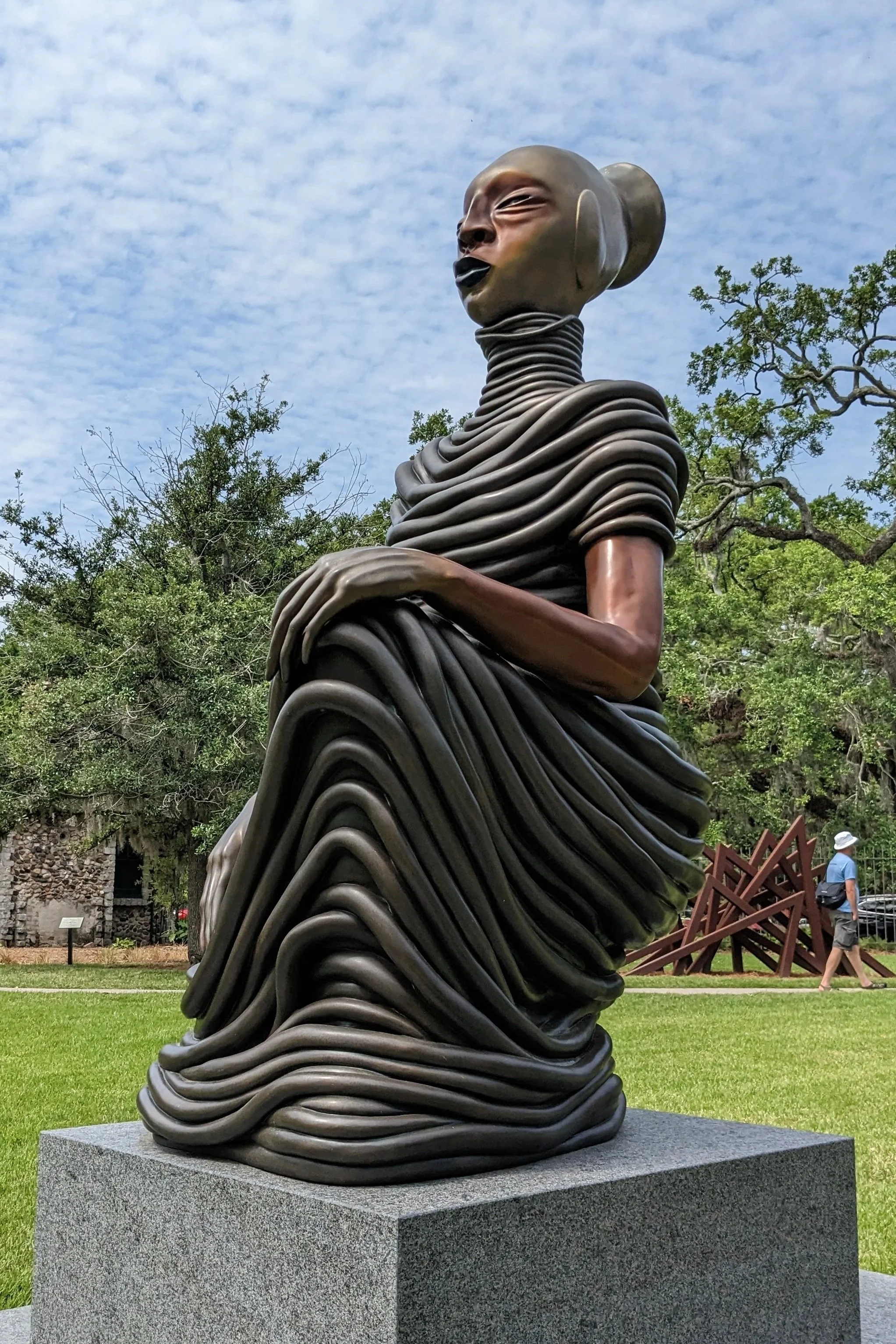
Wangechi Mutu’s The Seated III, ©Nicole Bratt – New Orleans Museum of Art Besthoff Sculpture Garden