What Is The Kosha Model?
/
Love Letter to the PNW, MURAL by Nalisha Estrellas; photo ©Nicole Bratt
Hello friends,
One of the things that makes yoga therapy distinct from studio yoga classes, psychotherapy, physical therapy, or massage is the intentional way we work with the kosha model.
The koshas are described as layers or sheaths of our being. (See the illustration below.) This model reminds us that we are more than just a physical body, and more than just a mind. We are complex, layered beings.
At the center of all of this is something harder to define but deeply felt – our essential nature. Some call it spirit, soul, divine light, or life spark. What do you call it? Different traditions use different language. Whatever words resonate for you, there is often a recognition that something deep within us is both uniquely us and also connected to something larger.
The koshas describe the layers that surround and express that essence, which the yogis call atman – your true self.
This elegant framework is perfect for yoga therapy because a person may be doing well in one aspect while struggling in another. Someone may feel physically strong but emotionally depleted. Someone else may feel mentally sharp but deeply disconnected from joy or meaning.
The koshas help us look at the whole picture. They are typically taught from gross –> subtle.
Annamaya kosha – The first and most accessible layer: the physical body. This is your structure of skin, bones, muscles, fat, and connective tissues. It is the body you see in the mirror.
This layer is supported through things like movement, strength, mobility work, sleep, good nutrition, bodywork, and physical therapy. It is usually the easiest layer for people to understand because it feels tangible and concrete.
Pranamaya kosha is often translated as the energy body or life-force body. A common way to understand it is via the breath. Breath is one of the clearest expressions of prana, our life force. When breathing stops, life stops.
But pranamaya is not only about breath. It also includes our physiology which keep us alive and energized – circulation, nervous system activity, digestion, chemical signaling, and all the subtle cellular level processes happening inside us every living moment.
We support this layer through intentional breath practice, nourishment, hydration, balancing effort and rest, and by learning how to regulate and care for the nervous system.
Manomaya kosha is often understood as the thinking mind.
This is the layer of thoughts, reactions, emotions, opinions, beliefs, memories, expectations, and mental chatter. It is the part of us constantly planning, analyzing, predicting, solving problems, and telling stories.
For many of us, this layer is very busy.
Practices like meditation become especially helpful here. This is one reason the progression of a yoga practice can be so powerful: movement (asana) helps us arrive in the body, breath (pranayama) helps regulate our energy, and then meditation (dhyana and dharana) allows us to observe the mind more clearly.
Instead of automatically believing every thought or being hijacked by emotion, we begin to notice our patterns.
That space matters. It leads us to the next layer…
Vijnanamaya kosha is often called the wise mind or wisdom body. It is different from the busy thinking mind of the manomaya kosha. This is the deeper knowing beneath all the noise.
I often think of a snow globe. When everything is shaken up and moving, it’s hard to see clearly. But when the flurries settle, the image inside is easily revealed.
That is vijnanamaya – our innate discernment, intuition, insight, and truth. It is where we often recognize what is deeply aligned for us, even if that truth is inconvenient or difficult.
This layer helps us live with integrity. We often access this layer after Restorative yoga practice, deep meditation, a long savasana, or periods of quiet time in nature or away from the hustle-bustle.
Anandamaya kosha is the least tangible layer – the bliss body.
“Bliss” can sound lofty or abstract, but it’s not constant happiness. I think of it more as powerful moments of awe, joy, connection, presence, and flow.
You might experience it while making art, listening to music, holding a child, laughing with someone you love, summiting that mountain, or witnessing a spectacular sunset.
It is the feeling of being both deeply alive and deeply connected. We often don’t even realize we’re in it because we are so fully absorbed in presence. Sometimes we only recognize it once we’ve slipped out of it.
~
Many healing modalities work beautifully with one or even two koshas. Physical therapy may focus primarily on the physical body. Psychotherapy may focus heavily on mental and emotional patterns. Massage may support the physical + nervous systems.
Yoga therapy is unique because we intentionally look at the whole person. We aim to balance all the layers that serve the true self.
We explore questions like:
Where are you thriving?
Where are you depleted?
Which layers feel nourished, and which feel undernourished?
(And, of course, the answers can change from week to week, month to month, year to year.)
From there, we build practices that support the layers needing the most care.
The goal is not perfection.
The goal is greater balance, vitality, authenticity, and inner steadiness.
When these layers become more integrated, people often say something simple but profound:
“I feel more like myself again.”
That is the heart of yoga therapy – not becoming someone new, but remembering and befriending who you already are.
With love,
Nicole
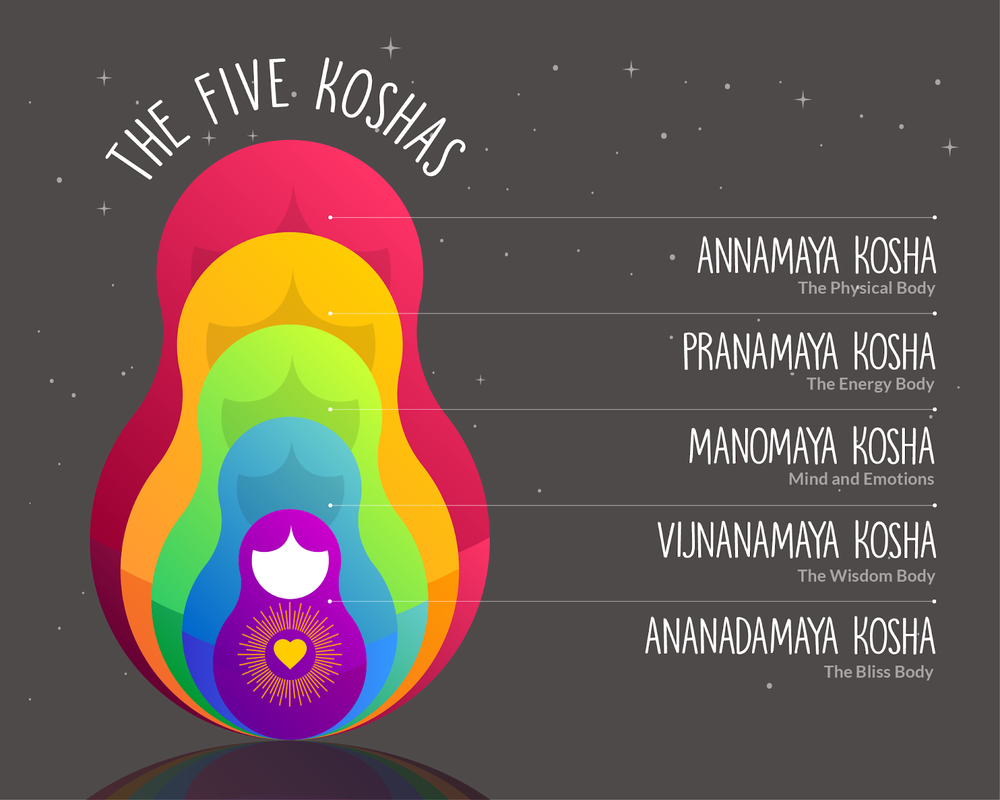
ILLUSTRATION FROM Mekosha Retreats & Botanicals